
| HOW THE BOAR'S HEAD & YULE LOG FESTIVAL CAME TO CHRIST CHURCH CATHEDRAL IN THE CITY OF CINCINNATI, USA |
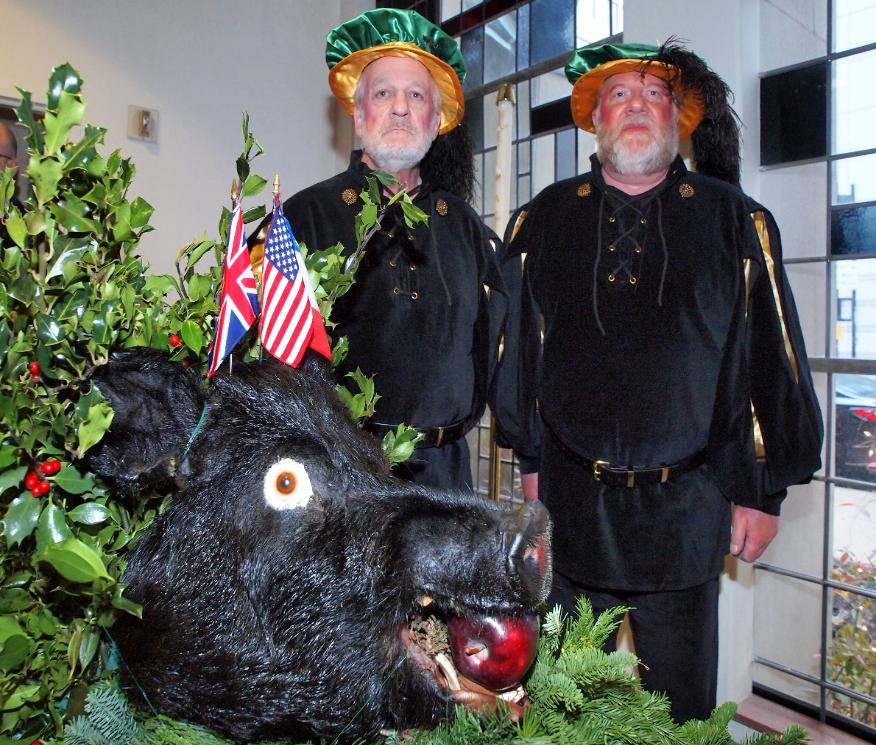
| The presentation of the Boar's Head can be traced back through the mists of time to when the boar was the first course served at a Roman banquet. Over time, the feast of the Boar's Head which featured pagan rituals of the winter solstice was integrated with the Christian observance of the birth of the Christ child. Given these deep roots, this pageant vies for the honor of being the oldest continuing celebration of the Christmas season. In medieval England, the ferocious wild boar was dubbed "king" of the forest; given its menacing appearance, this beast also served as a metaphor for evil. The display of the Boar's Head on a dish in the depth of winter heralded the triumph of good over evil. The Church accepted this custom with its good symbolic message and transformed it to the rejoicing of the birth of the Christ child and his ultimate victory over evil. The festival of the Boar's Head, together with the lighting of the yule log during the darkest time of the year became the light, warmth, hope, and joy of Christmas and the New Year. To keep up spirits, Twelve Days of Christmas revelry culminating in the feast of the Epiphany were celebrated throughout the homes and manor houses of the Middle Ages. The Boar's Head celebration was observed in the dining hall of Queen's College (founded 1341) of the University of Oxford. Tradition there recalls the confrontation between an Oxonian, who was on his way to Midnight Mass, and an upset wild boar. Having no weapon on him, the scholar rammed his metal bound book on Aristotle down the boar's throat. (Now you may ask why this scholar was carrying Aristotle to Christmas Mass?). Philosophical ruminations notwithstanding, the happy news is that in due course, the unlucky boar was served amidst merry carolling by the academicians in honor of the "king of bliss." During the next few centuries through Renaissance and Enlightenment, the procession was enlarged to include wise men or kings bearing gifts, shepherds, King Winceslas and his page, household knights and keepers, sometimes on a more solemn note, the martyr Stephen, and at some point in time, even the Yeomen Guards (then in the 16th century but now known as Yeomen Warders) of the Queen's Royal Palace and Fortress the Tower of London, affectionately known as "Beefeaters." Not to be outdone, the dinner menu incorporated those old standbys, mince pie and plum pudding, which when served by the kitchen companies with pomp to the tune of the Boar's Head Carol, were cheerfully consumed by all, visually and/or gastronomically. In the colonial days of early America, the Boar's Head and Yule Log Festival was initiated by the Bouton Family of Connecticut. This French Huegenot family had sojourned in England before immigrating to these shores. In 1888, a Bouton introduced the festival to the Hoosac School in New York State. In 1940, Christ Church in Cincinnati obtained permission from Hoosac and Frank Butcher, the musical arranger who came from Canterbury Cathedral, to present the Boar's Head and Yule Log Festival in the Queen City. At Christ Church (now Christ Church Cathedral) in Cincinnati, the dining hall festivities were transformed into the church celebration of today and tomorrow, to be enjoyed as God's gift to the people of Cincinnati and beyond. So now we know why each year there are three tiny flags perched on the Boar's Head of Christ Church Cathedral - Britain, France, and the United States of America. See you all next at the Boar's Head and Yule Log Festival at Christ Church Cathedral in the City of Cincinnati. To see the official website which includes information on the upcoming annual event, click here. Charleston C. K. Wang, 1/6/2009. To see the latest full page photonews of Boars Head and Yulelog Festival, click here. Copyright 2009 All Rights Reserved Charleston C. K. Wang, Esq. |

 |  |  |
Click on Photo
January 3, 2015