

For Upcoming Sunday
Seminars on Current
Issues at Christ Church
Cathedral in the City of
Cincinnati click here.
Seminars on Current
Issues at Christ Church
Cathedral in the City of
Cincinnati click here.

| To read "The Road to Emmaus," click here. |


THE ASIAN AMERICAN HOUR has gotten bigger - we are now on the air weekly on public radio WAIF-CINCINNATI 88.3 FM and our broadcast time has moved to prime-time THE ASIAN AMERICAN HOUR CONTINUES 15 YEARS ON THE AIR WITH WAIF 88.3 FM - Date of First Broadcast: 6/7/2001 THE ASIAN AMERICAN HOUR will continue to feature talk, and music, and other good things with a discernable slant towards Asian American affairs, immigration, and many other issues of interest to our community-at-large. THE ASIAN AMERICAN HOUR is produced and hosted by Charleston Wang with Mary Joan Reutter and John O'Neill as co-hosts, together with our distinguished guests. So, tune in to THE ASIAN AMERICAN HOUR on WAIF-CINCINNATI 88.3 FM. every Monday 5-6 PM. Get the latest on the Asian American community in Cincinnati, the fast growing & mobile community in the Tri-state. After listening to the THE ASIAN AMERICAN HOUR, e-mail us direct feedback and thoughts by clicking here. If you or a friend wish to be a guest on THE ASIAN AMERICAN HOUR, please let us know. Tune in to THE ASIAN AMERICAN HOUR every Monday 5 - 6 PM on WAIF 88.3 FM Cincinnati on the air, or listen Via internet streaming audio from anywhere in the world by clicking here. |

| THE ASIAN AMERICAN HOUR on WAIF 88.3 FM Cincinnati IS NOW A WEEKLY PRIME-TIME SHOW EVERY MONDAY EVENING 5 - 6 P.M. Informing the People of Cincinnati (and Beyond) since 6/7/2001. Listen via internet streaming audio by clicking here, CONTACT US AT asianamericanhour@wangnews.net |
To read old "First Page News," click here
| WANG NEWS SERVICE An Independent Source of News & Views |
GOT NEWS?
GOT
OPINION?
Send your information,
photographs, or
comments to
WANGNEWS for
consideration to be
published in WANG
NEWS SERVICE.
To send, use this
email address:
news@wangnews.net
GOT
OPINION?
Send your information,
photographs, or
comments to
WANGNEWS for
consideration to be
published in WANG
NEWS SERVICE.
To send, use this
email address:
news@wangnews.net
 |
 |
 |
 |
 |
 |
 |
 |
 |
 |

Mary Ellen O'Connell

Photocredit: Mary Joan Reutter
Reach out to the
decision-makers, opinion-
agents of Greater
Cincinnati and the World.
ADVERTISE with
WANG NEWS SERVICE.
For terms and conditions,
you are invited to inquire
by email:
advertise@wangnews.net
decision-makers, opinion-
agents of Greater
Cincinnati and the World.
ADVERTISE with
WANG NEWS SERVICE.
For terms and conditions,
you are invited to inquire
by email:
advertise@wangnews.net

| Current U. S. Eastern Time: |
GOT RICE?
| Those who would give up Essential Liberty to purchase a little Temporary Safety, deserve neither Liberty nor Safety - Benjamin Franklin (1759). |
| To read "A Reflection of Jerusalem and the New Jerusalem from the Ground," click here. |
May 2016 Extra
For April 2016 Extra Click Here
For April 2016 Extra Click Here

| WANGLAW Attorneys & Counselors at Law |
| To read "Confession of a Gentile in Jerusalem: The Paradox of the Five Sheklim Blessing," click here. |
CLICK HERE TO SEE
INDEX OF OP-EDS
INDEX OF OP-EDS
| To view "Into the Heat of the Hebron Cauldon," \click here. |
Free
Download
Download


| To view "The Garden of Gethsemane and Church of All Nations," click here. |
| SEARCH WANGNEWS |

| SEARCH WANGNEWS |

| From Left to Right - Charleston C. K. Wang, Esq., Professor Mary Ellen O'Connell & Dean Gordon A. Christenson, Emeritus University of Cincinnati College of Law |

| BUSINESS MANNERS FOR SUCCESS BY MARJA WADE BARRETT IS AVAILABLE FROM THE CHRIST CHURCH CATHEDRAL SHOP AT 318 E. 4th STREET (4th & SYCAMORE) Pick up your copy by visiting the shop on location or via the internet. For more information, please, click here. |

| To view "Pilgrimage to Bethlehem, Birthplace of Jesus, click here. |


| VOLUNTEER PHYSICIANS OF MERCY CARE CLINIC: From Left to Right: DR. TARIQ SULTAN, DR. NEMAT MOUSSAVIAN, DR. DAN ROTH |
| To view "Herodion: A Fortress During the Gospels," click here. |

| To read"The Wilderness of Abraham, Jesus & Israel- Palestine," click here. |
| To view "In Search of the Messianic Secret - Caesarea Phillipi," click here. |


| To read "Descending to the Dead Sea and Ascending to Qumran," click here. |

| To read "Jury for Jericho," click here. |
| To view "The Empty Tombs," click here. |

| A Partnership between Mercy Hospital Anderson and Muslim Clinic of Ohio |
| To view "The Call for Simon Peter, Fisherman," click here. |
| To view "Caesarea Maritima as Known to Saint Paul," click here. |

| THE HOLY ISLE OF PATMOS Click here or on photo to see WANGNEWS Special |

| To view "Two Very Different Houses" click here. |

| EPHESUS OF ST. PAUL & ST. JOHN Click here or on photo to see WANGNEWS Special |

To view
"The Holy
Isle of
Patmos"
click here.
"The Holy
Isle of
Patmos"
click here.

To view
"Sufis
Rumi
Konya,"
click
here.
"Sufis
Rumi
Konya,"
click
here.


| MEDITATING MEDITERRANEAN Click here or on photo to see WANGNEWS Special |
| THE WRATH OF PAUL Click here or on photo to see WANGNEWS Special |


To view
"Wrath
of
Paul,"
click
here.
"Wrath
of
Paul,"
click
here.
To view
"Medita-
ting Medi-
terra-nean,"
click here.
"Medita-
ting Medi-
terra-nean,"
click here.
TO RETURN TO FIRST PAGE NEWS, CLICK HERE CLICK TO GO TO >PAGE 1> >PAGE 2> >PAGE 3> >PAGE 4> >PAGE 5> >PAGE 6> >PAGE 7> >PAGE 8> >PAGE 9> >PAGE10> >PAGE11> >PAGE 12> >PAGE 13> >PAGE 14> >PAGE 15> >PAGE 16> Photocredit for this page: Charleston C. K. Wang |
 |  |  |
| To view "Caesarea Maritima as Known to Saint Paul," click here. |

| To view "The Call for Simon Peter, Fisherman," click here. |


To read "In Search of Lazarus," click here. |


| To view "In The Upper Room" click \here. |

| To view "The Church of St. Peter in Gallicantu" click here. |
| To view "Visitng the Dome of the Rock" click here. |

| To view Group photos of Cincinnati Pilgrims in Jerusalem click here. |


| PLEASE CLIICK ON PHOTO TO SEE COMPLETE PHOTONEWS SPECIAL ON "THE FACES OF TURKEY." |

THE FACES OF TURKEY
| EVERY MONDAY EVENING 5 - 6 P.M. |
| EVERY MONDAY EVENING 5 - 6 P.M. |
V More Photonews to come. Visit www.wangnews.net again and soon! V V |

| INFOCUS: CHEMICAL WEAPONS & THE HUMANITARIAN CRISIS IN SYRIA Click on Photo |
Bill Bell and Charleston C. K. Wang |

| SELECT PHOTOGRAPHS BY CHARLESTON WANG ARE ON THE NATIONAL GEOGRAPHIC WEBSITE Click on Photo to View |

| BE THE CHANGE: CIVIL RIGHTS & IMMIGRATION REFORM IN 2013 |
Robert Harris & Charleston C. K. Wang |
| Current U. S. Eastern Time: |
To view
"Ephesus
of St. Paul
and
St. John"
click here.
"Ephesus
of St. Paul
and
St. John"
click here.

A REAL UZBEK DYNASTY
| Four Elders from Uzbekistan in their many colored coats Photocredit: Boris Yusupov |

Bill Bell and Charleston C. K. Wang |
| INFOCUS: UNIVERSAL EDUCATION IN THE WORLD - Example of Malala Yousafzai Click on Photo |


| Charge of Light Brigade-Lord Alfred Tennyson Last of Light Brigade-Rudyard Kipling Recessional (Victorian Ode)-Rudyard Kipling |

CLICK ON PHOTO
CLICK ON PHOTO

A WIN IN THE U.S. SIXTH CIRCUIT COURT OF APPEALS. On August 18, 2014 in Nifadev v. Holder, (Case No. 13-3704/4222
6th Cir. 2014), the United States Court of Appeals for the Sixth Circuit held that Mikheil B. Nifadev has proven his claim that he
had suffered persecution by reason of his Russian ethnicity at the hands of the security and regular police of Uzbekistan. The
Court vacated the decision of the Board of Immigration Appeals (BIA) in Washington, D.C. which had denied Mr. Nifadev asylum,
and the Court remanded the case with additional instructions to the United States Attorney General, including that the BIA should
determine whether the BIA should also reconsider its denial of Nifadev’s application for withholding of removal and protection
under Convention Against Torture (abbreviated CAT for Convention Against Torture And Other Cruel, Inhuman or Degrading
Treatment or Punishment of the United Nations) in light of the opinion of the Court. The Sixth Circuit opinion essentially and
explicitly held that "[b]ecause the IJ [Immigration Judge] appears to have erred in her determination that Nifadev did not suffer
past persecution and because the IJ clearly misinterpreted Nifadev’s credible testimony regarding the ethnic animus of the
Uzbekistan security officials, we find that Nifadev has made out a credible case of being a refugee under the definitions of
8 U.S.C. § 1158(b)(1)(A)." [Emphasis added]. The United States Immigration Court in Cleveland, Ohio, had initially
found Mr. Nifadev and his witnesses to be credible but declined to grant asylum because it erroneously determined that
Mr. Nifadev had NOT suffered persecution. Shown in photograph on the right is Mr. Mikheil B. Nifadev with Charleston
C. K. Wang, Esq. who represented Mr. Nifadev during trial and both appeals. To read complete opinion, please click here.
6th Cir. 2014), the United States Court of Appeals for the Sixth Circuit held that Mikheil B. Nifadev has proven his claim that he
had suffered persecution by reason of his Russian ethnicity at the hands of the security and regular police of Uzbekistan. The
Court vacated the decision of the Board of Immigration Appeals (BIA) in Washington, D.C. which had denied Mr. Nifadev asylum,
and the Court remanded the case with additional instructions to the United States Attorney General, including that the BIA should
determine whether the BIA should also reconsider its denial of Nifadev’s application for withholding of removal and protection
under Convention Against Torture (abbreviated CAT for Convention Against Torture And Other Cruel, Inhuman or Degrading
Treatment or Punishment of the United Nations) in light of the opinion of the Court. The Sixth Circuit opinion essentially and
explicitly held that "[b]ecause the IJ [Immigration Judge] appears to have erred in her determination that Nifadev did not suffer
past persecution and because the IJ clearly misinterpreted Nifadev’s credible testimony regarding the ethnic animus of the
Uzbekistan security officials, we find that Nifadev has made out a credible case of being a refugee under the definitions of
8 U.S.C. § 1158(b)(1)(A)." [Emphasis added]. The United States Immigration Court in Cleveland, Ohio, had initially
found Mr. Nifadev and his witnesses to be credible but declined to grant asylum because it erroneously determined that
Mr. Nifadev had NOT suffered persecution. Shown in photograph on the right is Mr. Mikheil B. Nifadev with Charleston
C. K. Wang, Esq. who represented Mr. Nifadev during trial and both appeals. To read complete opinion, please click here.


Pursuant to the Sixth Circuit opinion, the BIA on January 5, 2015, ordered the Immigration Court to grant asylum to Mr. Nifadev.
To read the BIA order, please click here.
To read the BIA order, please click here.
WANGNEWS BLOG PAGE IS BACK - CHECK IT OUT BY CLICKING HERE |
To send WANGNEWS Feedback, please click here


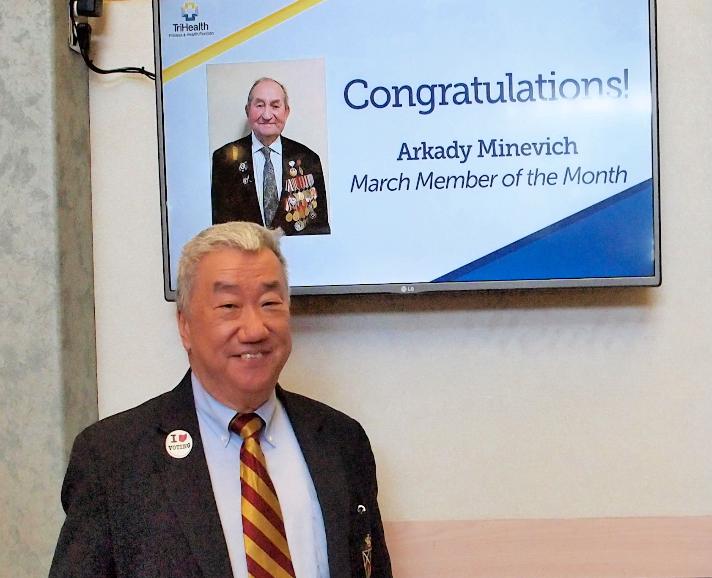
| Trihealth Pavilion 2015 SWIM THE COAST T-Shirt Awarded Distance Swim THIRTY FIVE (35) MILES March 2015 |
| Working the Tan Lines by the Aegean of the Mediterranen Beyond in the mist rises fabled Patmos, May 2012 |
| Working the Tan Lines on the bank of the Dead Sea the Lowest Body of Water on Earth more than 1300 feet below Sea Level April 2010. Somewhere near lie biblical Sodom & Gomorrah. |
April 25 - What it means to be a new Citizen with Mary Joan Reutter, Esq. May 2 - Professor K C Wong, Policing in Mongkok May 9 - Professor K C Wong, What it takes to be a good police chief, a good police department May 16- Leila Kubesh Talk About What She is Doing Against Bullying in Schools May 23 - Professor K C Wong, What it takes to be a good police chief, a good police department |
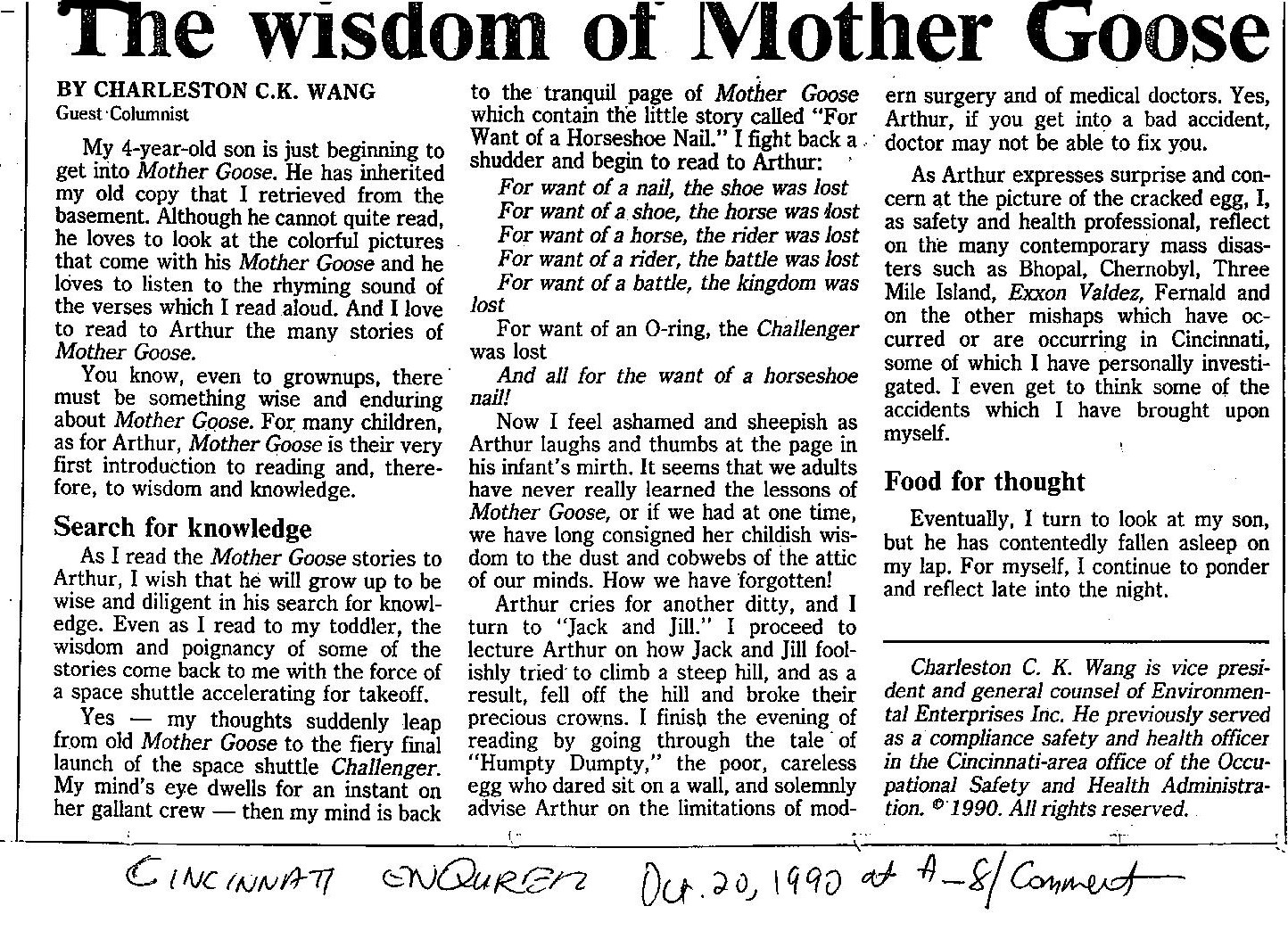
WE REMEMBER THE CHALLENGER & HER CREW
The Space Shuttle Challenger and all her crew were lost
in a fiery explosion 73 seconds after lift-off on January
28,1986. Since that moment so graphically captured on
film, 30 years have passed, but to me and many of us, it
was like yesterday as the fuel that was supposed to propel
the vessel into mission orbit leaked and ignited to provide
the cloud on a cloudless winter day. During those days, I
was very much involved in industrial safety having served
in the United States Department of Labor, Occupational
Safety and Health Administration. Accident investigations
and more importantly accident prevention were my
professional interest. In that spirit, I wrote an Op-Ed
entitled The Wisdom of Mother Goose and it was
published by the CINCINNATI ENQUIRER. Looking
back, and my son is an adult now, I feel gratified that
simple wisdom holds true to this day.
Today we should take time to remember the crew of the
Challenger, amongst whom was an Asian American.
Here are the names of that gallant crew:
Francis R. Scobee, Commander
Michael J. Smith, Pilot
Ronald McNair, Mission Specialist
Ellison Onizuka, Mission Specialist
Judith Resnik, Mission Specialist
Gregory Jarvis, Payload Specialist
Christa McAuliffe, Payload Specialist
The catastrophe was investigated by a Presidential
Commission which issued the Rogers Report. Among
conclusions was the finding that the ignition resulted
from the rupture in the O-rings seals to the aft field joint on
the right solid rocket booster. Pressurized hot gases and
eventually flame "blew by" the gaskets and reached the
adjacent external fuel tank, causing structural failure and
the explosion that destroyed the space shuttle on its 10th
mission into space. There was a design flaw in the
specification for the polymer material used in the O-rings
which made them prone to failure from lower ambient
temperatures. The Rogers Report is now a benchmark on
catastrophic failure incidents. Charleston C. K. Wang,
January 28, 2016.
The Space Shuttle Challenger and all her crew were lost
in a fiery explosion 73 seconds after lift-off on January
28,1986. Since that moment so graphically captured on
film, 30 years have passed, but to me and many of us, it
was like yesterday as the fuel that was supposed to propel
the vessel into mission orbit leaked and ignited to provide
the cloud on a cloudless winter day. During those days, I
was very much involved in industrial safety having served
in the United States Department of Labor, Occupational
Safety and Health Administration. Accident investigations
and more importantly accident prevention were my
professional interest. In that spirit, I wrote an Op-Ed
entitled The Wisdom of Mother Goose and it was
published by the CINCINNATI ENQUIRER. Looking
back, and my son is an adult now, I feel gratified that
simple wisdom holds true to this day.
Today we should take time to remember the crew of the
Challenger, amongst whom was an Asian American.
Here are the names of that gallant crew:
Francis R. Scobee, Commander
Michael J. Smith, Pilot
Ronald McNair, Mission Specialist
Ellison Onizuka, Mission Specialist
Judith Resnik, Mission Specialist
Gregory Jarvis, Payload Specialist
Christa McAuliffe, Payload Specialist
The catastrophe was investigated by a Presidential
Commission which issued the Rogers Report. Among
conclusions was the finding that the ignition resulted
from the rupture in the O-rings seals to the aft field joint on
the right solid rocket booster. Pressurized hot gases and
eventually flame "blew by" the gaskets and reached the
adjacent external fuel tank, causing structural failure and
the explosion that destroyed the space shuttle on its 10th
mission into space. There was a design flaw in the
specification for the polymer material used in the O-rings
which made them prone to failure from lower ambient
temperatures. The Rogers Report is now a benchmark on
catastrophic failure incidents. Charleston C. K. Wang,
January 28, 2016.
| CINCINNATI ENQUIRER - October 20, 1990 at A-8/Comment |
Charleston C K Wang Speedo
Charleston C K Wang Speedo
The future doesn't belong to the fainthearted; it belongs to the brave...We will never forget them, nor the last time we saw them, this
morning, as they prepared for their journey and waved goodbye and 'slipped the surly bonds of Earth' to 'touch the face of God.'
President Ronald Reagan remembering the Challenger crew.


American Pastime
WEDNESDAY, MAY 4, 2016
6:00 p.m. Reception
6:30 p.m. Film Screening
Harriet Tubman Theater
National Underground Railroad Freedom Center
50 East Freedom Way
Cincinnati, OH 45202
To RSVP, click here.
American Pastime, produced by Emmy award-winning producer, Barry Rosenbush, reveals the story of
another dark period in American history—the internment of Japanese Americans during World War II—
through the lens of America’s great pastime, baseball. The film follows the story of the Nomura family,
beginning from their internment in the Topaz War Relocation Center in 1941, and their struggle to remain
hopeful through America’s bleak and heightened sense of paranoia, prejudice and discrimination towards
Japanese Americans. For these relocated and displaced families, baseball becomes a valuable means in
which they cope with the unmanageable.
Barry Rosenbush and Kerry Yo Nakagawa an author, filmmaker, producer and historian will participate in a
panel discussion following the screening.
The screening of American Pastime is in partnership with Greater Cincinnati & Northern Kentucky Film
Commission and the Center for Holocaust and Humanity Education. This event is free and open to the public.
The Freedom Film Series is sponsored by Chubb Group of Insurance Companies.
WEDNESDAY, MAY 4, 2016
6:00 p.m. Reception
6:30 p.m. Film Screening
Harriet Tubman Theater
National Underground Railroad Freedom Center
50 East Freedom Way
Cincinnati, OH 45202
To RSVP, click here.
American Pastime, produced by Emmy award-winning producer, Barry Rosenbush, reveals the story of
another dark period in American history—the internment of Japanese Americans during World War II—
through the lens of America’s great pastime, baseball. The film follows the story of the Nomura family,
beginning from their internment in the Topaz War Relocation Center in 1941, and their struggle to remain
hopeful through America’s bleak and heightened sense of paranoia, prejudice and discrimination towards
Japanese Americans. For these relocated and displaced families, baseball becomes a valuable means in
which they cope with the unmanageable.
Barry Rosenbush and Kerry Yo Nakagawa an author, filmmaker, producer and historian will participate in a
panel discussion following the screening.
The screening of American Pastime is in partnership with Greater Cincinnati & Northern Kentucky Film
Commission and the Center for Holocaust and Humanity Education. This event is free and open to the public.
The Freedom Film Series is sponsored by Chubb Group of Insurance Companies.
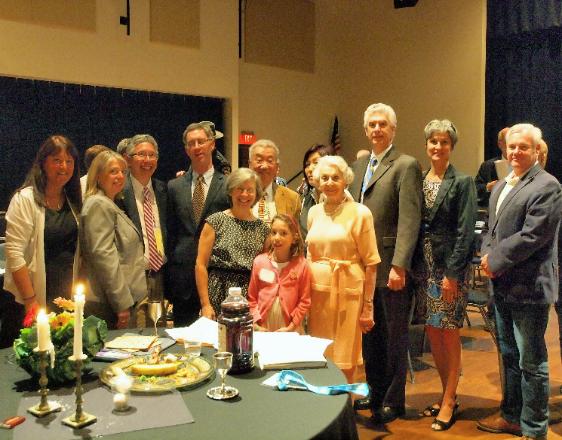
| READERS OF THE 2016 AJC COMMUNITY INTERGROUP PASSOVER SEDER |
| April 19, 2016 at the Mayerson JCC, Cincinnati, Ohio Led by Rabbi Matthew Kraus To my left, partially hidden is Yasue Kuwahara, JACL |


| FROM FEAR TO FREEDOM - CONFRONTING ISLAMOPHOBIA AT THE NATIONAL UNDERGROUND RAILROAD FREEDOM CENTER, CINCINNATI, OHIO APRIL 13, 2016 |
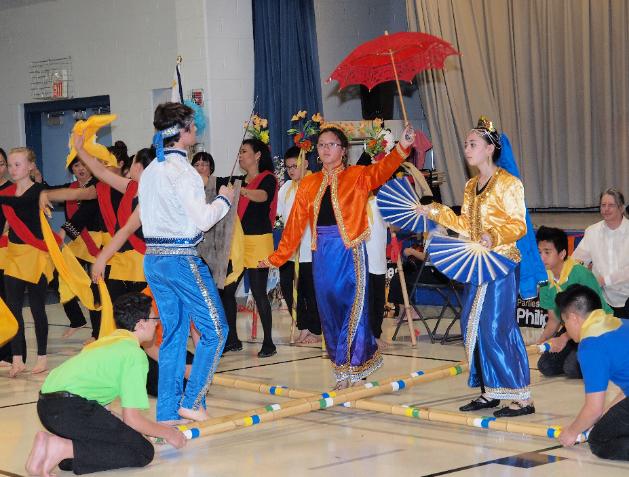

| FILIPINO ASSOCIATION OF SOUTHERN OHIO PISTA SA NAYON, 4/2/2016, CINCINNATI OHIO |
| Doing the Singkil of the Maranao |
| With FASOSO President Suzy Hussey |
Tao in the Shanghai Ghetto
Sarah Weiss invited me to attend the 2016 Yom Ha Shoah (Day of Holocaust Remembrance) at the Mayerson Jewish Community Center. Being my usual self, I took the
opportunity to take some photos, a sample of them you can see here. I always knew that Dr. Albert Weisbrot, my long-time physician of great Tao cheer, can sing but to hear
him up close without the stethoscope. All doctor-patient humor aside, the event was a reality check and we must never forget every person has a name and a personal story to be
remembered. However, I left the service with a recurring thought put to me by the keynote speaker Sarah Wildman when she mentioned Shanghai as one of the cities of refuge
from the terror of the Holocaust.
Indeed, the connection to Shanghai is history and all I, as an immigration, nationality and asylum lawyer, can do is brief the story of the Shanghai Ghetto. The Shanghai Ghetto
existed from 1937-1945 inside the International Settlement of the most cosmopolitan of the cities of China. Jewish businesses were already established and flourishing before 1937,
prominent among them were Ashkenazi families who had fled the Russian Revolution in 1917 and wealthy Sephardic Jews from Iraq. The first Jewish families fleeing the Nazis
arrived in Shanghai in 1933. By the second half of the 1930's, after the Nuremberg Laws were passed (in 1935 which included statutes against miscegenation), cities of refuge in
the West were strained by the increase in Jewish asylum seekers. The Evian Conference in 1938 raised severe quotas to entry into western countries including asylum in the
United States. Shanghai kept her portals open. After the Anschluss (Annexation of Austria by the Third Reich in March 1938), Jews from Austria also found refuge in Shanghai.
More came after Kristallnacht (1938).
Even after the Battle of Shanghai in 1937 when the greater part of that great city was violently seized by the Imperial Japanese Army, Jewish asylum seekers could enter the
distressed city without visa or passport. But Shanghai being on the eastern coast of China was difficult to reach. From 1938-1940, thousands of Austrian Jews were saved by the
Chinese consul-general in Vienna Ho Feng-Shan,/1/ who against the orders of the Chinese ambassador in Berlin, Chen Jie, granted "protective" visas to enter China.
During 1940 after the occupation of Poland, Chiune Sugihara,/2/ the Japanese consul in Kaunas, Lithuania issued personally hand-written visas to Jews from Poland and Lithuania
and arranged for them to travel on the Trans-Siberian railway to Vladivostok, and then by boat to Kobe, Japan. Tadeusz Romer, the Polish ambassador in Tokyo helped them to
disperse to sanctuary cities including Shanghai.
It is estimated that during the War, 18,000 Jews lived in Shanghai (a modest number especially when compared to the 6 miilion murdered during the Holocaust). In April 1941,
a new Ashkenazic Jewish synagogue was built in addition to the Ohel Moshe Synagogue built by Russian Jews in 1907 (presently the Shanghai Jewish Refugees Museum located
in the Hongkou District). After Pearl Harbor, American charitable support was cut off and the established wealthier Baghdadi Jews being British subjects were interned as well.
As the Second World War intensified, the Jewish settlement in Shanghai (residents were officially designated as "stateless refugees") became squeezed into a less than one square
mile ghetto with the overcrowded housing euphemistically called "Heim of the Little Vienna."
The terrible scourge of war afflicted many but not all. With the Tripartite Pact of 1940, Japan became an Axis power marching in step with Nazi Germany. Inevitably, the Nazis
stepped up their demands on their Japanese ally to turn over the Shanghai Jews. There is a published anecdote involving the Japanese military governor of Shanghai who had
summoned Rabbi Shimon Sholom Kalish, inquiring him as to why the Third Reich hate you so much? Without hesitation and knowing the fate of his community hung on his
answer, Reb Kalish told the translator (in Yiddish): "Zugim weil wir senen orientalim —Tell him it is because we are Orientals." The governor, whose face had been stern throughout
the confrontation, broke into a slight smile. In spite of the military alliance, he did not accede to the German demand and the Shanghai Jews were never handed over. /3/
The Government of Israel has conferred the honor of the Righteous Among the Nations to Chiune Sugihara in 1985 and to Ho Feng-Shan in 2000. Among those saved in the
Shanghai Ghetto were leaders and students of Mir Yeshiva which began in Belarus (and now in Jerusalem). Thus is the Tao in the Shanghai Ghetto affectionately known to the
world as the Little Vienna.
Charleston C. K. Wang, May 1, 2016.
FN 1 Ho Feng-Shan went with the Kuomintang Government to Taiwan in 1949 and served as ambassador to many countries. He retired from diplomatic service in 1973, and
immigrated to San Francisco, California, where he wrote his memoirs, My Forty Years as a Diplomat (外交生涯四十年) published in 1990 (English translation 2010). On September 28,
1997, Ho Feng-Shan died in San Francisco at the age of 96.
FN2 Chiune Sugihara was captured at his post in Bucharest, Romania in 1944 by the Soviets and was a POW for 18 months before being repatriated to Japan via the Trans-Siberian
railway and the Russian port of Nakhodka. His diplomatic career ended in 1947, which according to his wife Yukiko Sugihara, was a resignation imposed for that "Lithuanian incident."
He died in Kamakura on July 31, 1986 and his story was virtually unknown inside Japan. His funeral was attended by a Jewish delegation headed by the Israeli Ambassador.
FN 3 The Rabbi of 84th Street: The Extraordinary Life of Haskel Besser by Warren Kozak (HarperCollins, 2004) p.177. In 2000, a documentary flim captioned "The Shanghai Ghetto"
was produced by Dana Janklowicz-Mann and Amir Mann.
For WANGNEWS photonews of Yad Vashem, please click here.
Sarah Weiss invited me to attend the 2016 Yom Ha Shoah (Day of Holocaust Remembrance) at the Mayerson Jewish Community Center. Being my usual self, I took the
opportunity to take some photos, a sample of them you can see here. I always knew that Dr. Albert Weisbrot, my long-time physician of great Tao cheer, can sing but to hear
him up close without the stethoscope. All doctor-patient humor aside, the event was a reality check and we must never forget every person has a name and a personal story to be
remembered. However, I left the service with a recurring thought put to me by the keynote speaker Sarah Wildman when she mentioned Shanghai as one of the cities of refuge
from the terror of the Holocaust.
Indeed, the connection to Shanghai is history and all I, as an immigration, nationality and asylum lawyer, can do is brief the story of the Shanghai Ghetto. The Shanghai Ghetto
existed from 1937-1945 inside the International Settlement of the most cosmopolitan of the cities of China. Jewish businesses were already established and flourishing before 1937,
prominent among them were Ashkenazi families who had fled the Russian Revolution in 1917 and wealthy Sephardic Jews from Iraq. The first Jewish families fleeing the Nazis
arrived in Shanghai in 1933. By the second half of the 1930's, after the Nuremberg Laws were passed (in 1935 which included statutes against miscegenation), cities of refuge in
the West were strained by the increase in Jewish asylum seekers. The Evian Conference in 1938 raised severe quotas to entry into western countries including asylum in the
United States. Shanghai kept her portals open. After the Anschluss (Annexation of Austria by the Third Reich in March 1938), Jews from Austria also found refuge in Shanghai.
More came after Kristallnacht (1938).
Even after the Battle of Shanghai in 1937 when the greater part of that great city was violently seized by the Imperial Japanese Army, Jewish asylum seekers could enter the
distressed city without visa or passport. But Shanghai being on the eastern coast of China was difficult to reach. From 1938-1940, thousands of Austrian Jews were saved by the
Chinese consul-general in Vienna Ho Feng-Shan,/1/ who against the orders of the Chinese ambassador in Berlin, Chen Jie, granted "protective" visas to enter China.
During 1940 after the occupation of Poland, Chiune Sugihara,/2/ the Japanese consul in Kaunas, Lithuania issued personally hand-written visas to Jews from Poland and Lithuania
and arranged for them to travel on the Trans-Siberian railway to Vladivostok, and then by boat to Kobe, Japan. Tadeusz Romer, the Polish ambassador in Tokyo helped them to
disperse to sanctuary cities including Shanghai.
It is estimated that during the War, 18,000 Jews lived in Shanghai (a modest number especially when compared to the 6 miilion murdered during the Holocaust). In April 1941,
a new Ashkenazic Jewish synagogue was built in addition to the Ohel Moshe Synagogue built by Russian Jews in 1907 (presently the Shanghai Jewish Refugees Museum located
in the Hongkou District). After Pearl Harbor, American charitable support was cut off and the established wealthier Baghdadi Jews being British subjects were interned as well.
As the Second World War intensified, the Jewish settlement in Shanghai (residents were officially designated as "stateless refugees") became squeezed into a less than one square
mile ghetto with the overcrowded housing euphemistically called "Heim of the Little Vienna."
The terrible scourge of war afflicted many but not all. With the Tripartite Pact of 1940, Japan became an Axis power marching in step with Nazi Germany. Inevitably, the Nazis
stepped up their demands on their Japanese ally to turn over the Shanghai Jews. There is a published anecdote involving the Japanese military governor of Shanghai who had
summoned Rabbi Shimon Sholom Kalish, inquiring him as to why the Third Reich hate you so much? Without hesitation and knowing the fate of his community hung on his
answer, Reb Kalish told the translator (in Yiddish): "Zugim weil wir senen orientalim —Tell him it is because we are Orientals." The governor, whose face had been stern throughout
the confrontation, broke into a slight smile. In spite of the military alliance, he did not accede to the German demand and the Shanghai Jews were never handed over. /3/
The Government of Israel has conferred the honor of the Righteous Among the Nations to Chiune Sugihara in 1985 and to Ho Feng-Shan in 2000. Among those saved in the
Shanghai Ghetto were leaders and students of Mir Yeshiva which began in Belarus (and now in Jerusalem). Thus is the Tao in the Shanghai Ghetto affectionately known to the
world as the Little Vienna.
Charleston C. K. Wang, May 1, 2016.
FN 1 Ho Feng-Shan went with the Kuomintang Government to Taiwan in 1949 and served as ambassador to many countries. He retired from diplomatic service in 1973, and
immigrated to San Francisco, California, where he wrote his memoirs, My Forty Years as a Diplomat (外交生涯四十年) published in 1990 (English translation 2010). On September 28,
1997, Ho Feng-Shan died in San Francisco at the age of 96.
FN2 Chiune Sugihara was captured at his post in Bucharest, Romania in 1944 by the Soviets and was a POW for 18 months before being repatriated to Japan via the Trans-Siberian
railway and the Russian port of Nakhodka. His diplomatic career ended in 1947, which according to his wife Yukiko Sugihara, was a resignation imposed for that "Lithuanian incident."
He died in Kamakura on July 31, 1986 and his story was virtually unknown inside Japan. His funeral was attended by a Jewish delegation headed by the Israeli Ambassador.
FN 3 The Rabbi of 84th Street: The Extraordinary Life of Haskel Besser by Warren Kozak (HarperCollins, 2004) p.177. In 2000, a documentary flim captioned "The Shanghai Ghetto"
was produced by Dana Janklowicz-Mann and Amir Mann.
For WANGNEWS photonews of Yad Vashem, please click here.
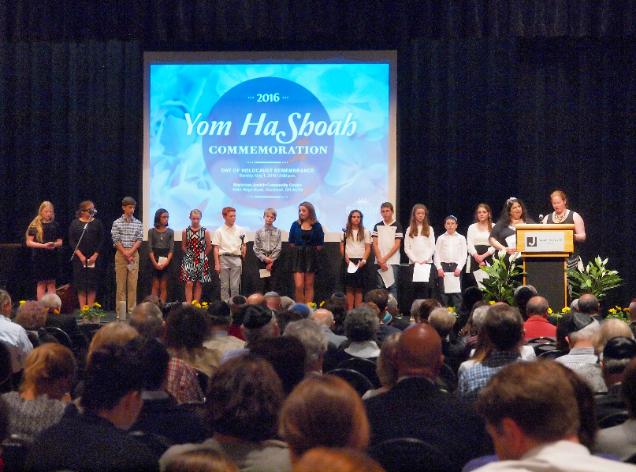
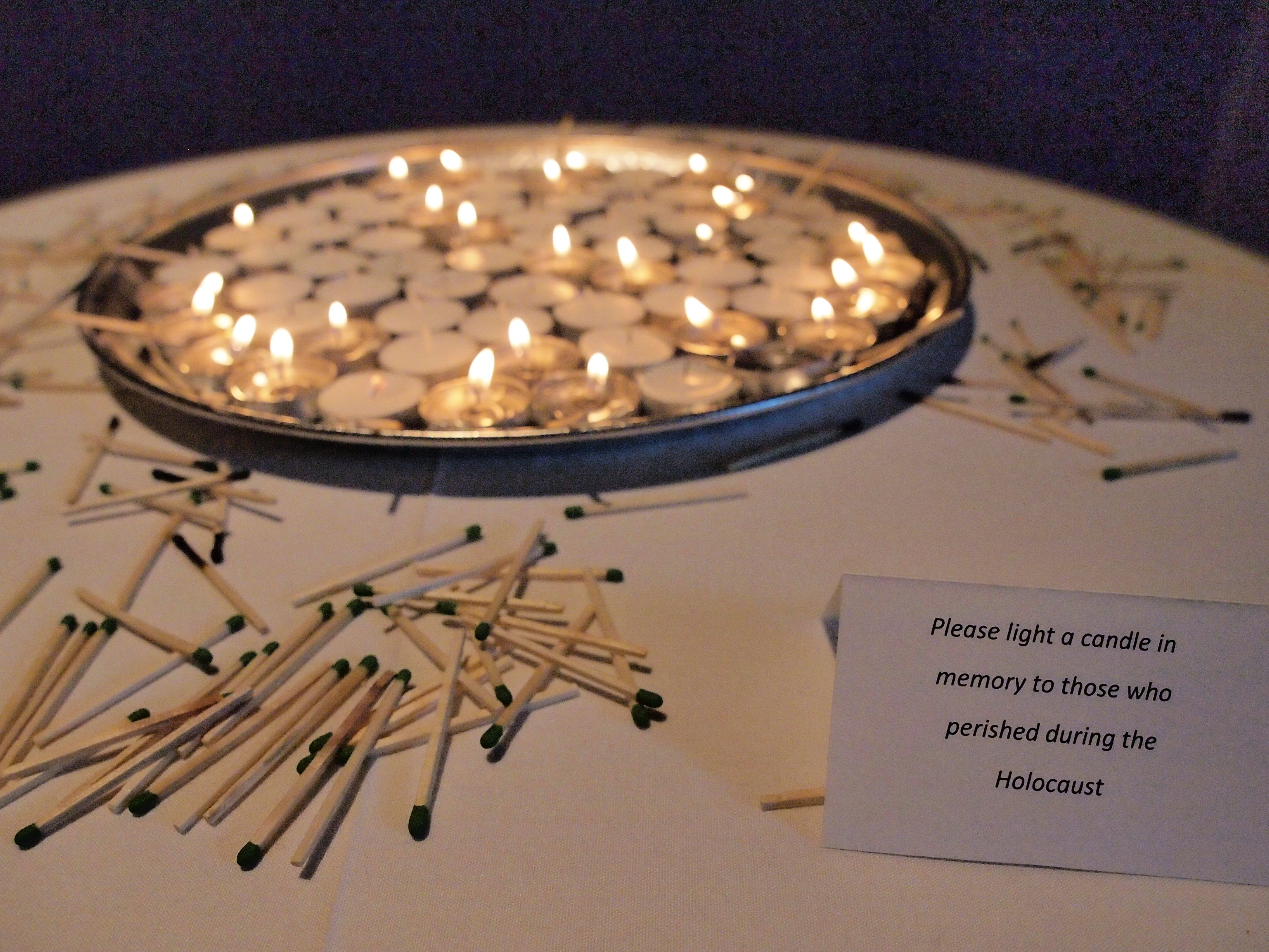
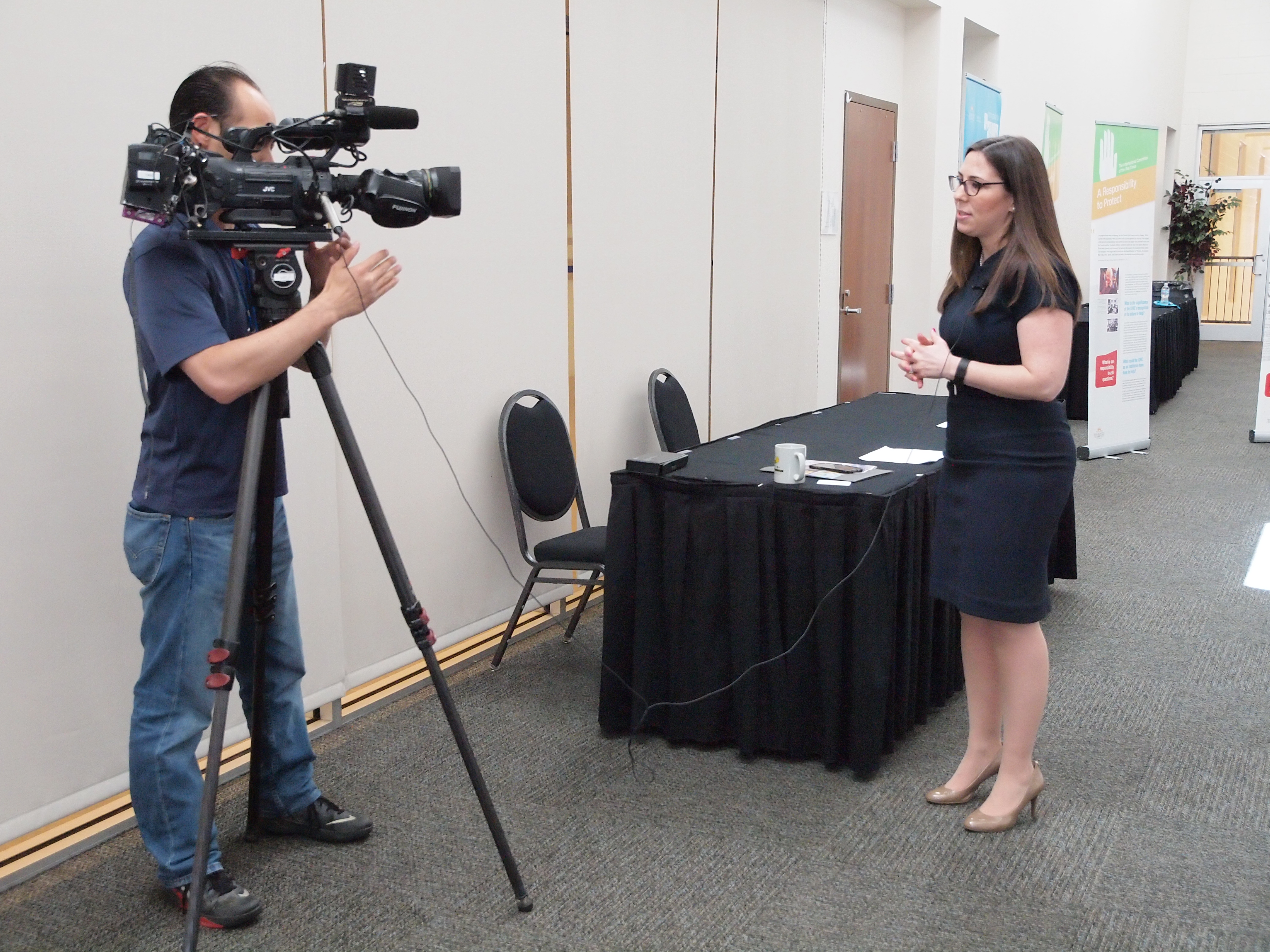
| DAY OF HOLOCAUST REMEMBRANCE - MAY 1, 2016 AT THE MAYERSON JEWISH COMMUNITY CENTER, CINCINNATI, OHIO, USA |
| SARAH WEISS Executive Director Center for Holocaust & Humanity Education |
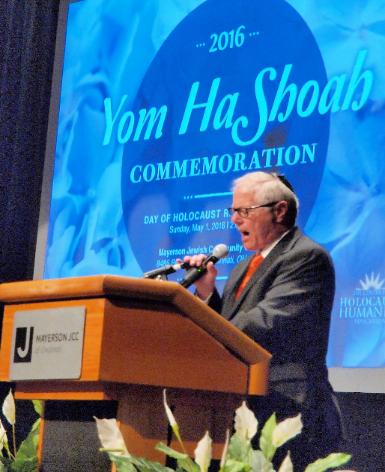
| ALBERT WEISBROT, M.D. EL MALEI RACHAMIN & MOURNER'S KADISH When not singing doleful songs this physician prescribes to me the elixir bread of longevity |
Click on Photo
犹太难民在上海
STRICT SCRUTINY IS NOT A PANACEA: THE HISTORICAL LIMITS OF CONSTITUTIONAL JUDICIAL REVIEW IN NATIONAL SECURITY CASES
Strict scrutiny as a form of judicial review is taught in law schools and practiced in the United States courts today. Strict scrutiny is the most rigorous standard applied by the federal judiciary to
balance the power of government on one hand and the vindication of a constitutionally protected right on the other. While the "levels of judicial scrutiny" may be traced to a footnote in \the
U. S. Supreme Court decision, United States v. Carolene Products Co. (1938), the actual articulation of strict scrutiny as a standard of judicial review occurred in the World War II Japanese-
American internment case of Korematsu v. United States (1944).
Similarity to Dred Scott and Plessy
This writer would respectfully suggest that Korematsu today can be thought of as a twentieth century case that resounds with the footsteps of Dred Scott v. Sandford (1857) and Plessy v. Ferguson
(1896). Dred Scott, most civil rights and civil liberty observers will recall, is that infamous Supreme Court decision which enunciated the principle of "once a slave, always a slave," and rejecting
Missouri's "once free, always free" judicial standard. This Taney Court decision squandered the opportunity to abolish slavery from within the judicial forum and was an ignomious failure that led
to and was bloodily repudiated by fire and steel in the Civil War (1861-65). Plessy is the post-Civil War decision of the Supreme Court which upheld the "separate but equal" underpinnings of
im Crow, a decision that lingered until the beginning in the 1950's when the Supreme Court begain to look at civil rights in a new light, and culminating in the Civil Rights legislation of the 1960's.
Taken together, Dred Scott and Plessy represent two landmark failures of the high court to mete justice in what we now know as civil rights. Presently, add to them Korematsu v. United States
as we shall now revisit.
Fred Korematsu Decides to Challenge Internment
Korematsu, albeit with 20-20 hindsight, similarly failed to protect the liberty interests of those American citizens of Japanese ancestry who were relocated into camps by Executive Order 9066
after the attack by imperial Japanese forces on Pearl Harbor in 1941. Fred Korematsu was a Japanese-American man who decided to stay in San Leandro, California and knowingly refused
to obey the order of the United States government. He was arrested and convicted regardless of his argument that E.O. 9066 violated the Fifth Amendment to the United States Constitution
(no person shall be deprived of life, liberty or property without due process of law). There was no question of Korematsu's loyalty to the United States. During the course of the litigation,
charges had been leveled that United States Solicitor withheld from the Court naval intelligence reports exonerating the Japanese Americans of spying and other acts of disloyalty
The U.S. Court of Appeals for the Ninth Circuit affirmed the conviction. The Supreme Court granted certiorari.
In the famous 6–3 decision, the Court found for the government and rejected Korematsu's constitutional challenge. Six of the eight Roosevelt appointees sided with the President.
A Justice Roberts of a previous century, entered a vigorous dissent which must be remembered:
"This is not a case of keeping people off the streets at night, as was Hirabayashi v. United States, nor a case of temporary exclusion of a citizen from an area for his own safety or that of the
community, nor a case of offering him an opportunity to go temporarily out of an area where his presence might cause danger to himself or to his fellows. On the contrary, it is the case of
convicting a citizen as a punishment for not submitting to imprisonment in a concentration camp, based on his ancestry, and solely because of his ancestry, without evidence or inquiry
concerning his loyalty and good disposition towards the United States. If this be a correct statement of the facts disclosed by this record, and facts of which we take judicial notice, I need
hardly labor the conclusion that Constitutional rights have been violated."
This the lone Justice appointed by a Republican President was joined by Justice Frank Murphy who passionately wrote:
"I dissent, therefore, from this legalization of racism. Racial discrimination in any form and in any degree has no justifiable part whatever in our democratic way of life. It is unattractive in any
setting, but it is utterly revolting among a free people who have embraced the principles set forth in the Constitution of the United States. All residents of this nation are kin in some way by
blood or culture to a foreign land. Yet they are primarily and necessarily a part of the new and distinct civilization of the United States. They must, accordingly, be treated at all times as the
heirs of the American experiment, and as entitled to all the rights and freedoms guaranteed by the Constitution."
The third dissent came from Justice Robert Jackson although he rather honestly conceded that "military decisions are not susceptible of intelligent judicial appraisal." came from Justice
Robert Jackson although he rather honestly conceded that "military decisions are not susceptible of intelligent judicial appraisal." But he added:'But once a judicial opinion rationalizes such
an order to show that it conforms to the Constitution, or rather rationalizes the Constitution to show that the Constitution sanctions such an order, the Court for all time has validated the
principle of racial discrimination in criminal procedure and of transplanting American citizens. The principle then lies about like a loaded weapon ready for the hand of any authority that can
bring forward a plausible claim of an urgent need.' After World War II ended, Justice Jackson was appointed by President Harry Truman and served as the Chief United States Prosecutor at the
Nuremberg Trials which convicted certain Nazis of war crimes, crimes
against humanity, and crimes against peace.
Thus Came and Then Comes Strict Scrutiny
As noted above, it was in Korematsu that the United States Supreme Court laid claim to the power to exercise judicial strict scrutiny and demand the government show a "compelling interest"
when its action applies to a "suspect classification," such as race or national origin. This maneuver recalls Marbury v. Madison (1803) through which the Marshall Court formulated the basis
for the exercise of judicial review and judicial supremacy in the United States. Should it be surprising that Marbury also left the petitioner for writ of mandamus, William Marbury, without a
remedy as was the fate of Fred Korematsu one and a half centuries later?/FN1/
Korematsu did however give the United States Supreme Court the opportunity to establish the doctrine of strict scrutiny which can be viewed as the twentieth century refinement of the judicial
review of old according to Marbury. Fred Korematsu can derive some comfort in knowing that since that first articulation of strict scrutiny, this modern doctrine has gone on to provide relief to
many civil rights (suspect class) claimants, to include the petitioners in such famous cases as inter alia (1) Brown v. Board of Education (1954), (2) Griswold v. Connecticut (1965),
(3) Loving v. Virginia (1967), (4) Roe v. Wade, (1973), and (5) quite recently United States v. Windsor, (2013).
Redress for Fred Korematsu and Other Internees
Coming back to Fred Korematsu and the infamy of the internment of Japanese Americans after Pearl Harbor which drew the United States into World War II, it was not until the 1980's that the
Korematsu, Hirabayashi, and Yasui cases would be reopened by petitions for coram nobis, proceedings that will eventually void the convictions of the 1940s. These petitions, however, ar
e docketed in the lower federal trial courts and may not have appellate stature and precedential authority. Nevertheless a "cure" after nearly half a century! Leadership for redress was
provided by the Japanese American Citizens League.
In 1988, President Ronald Reagan signed the Civil Liberties Act, and providing for financial redress of $20,000 for each surviving detainee. In 1992, President George H. W. Bush signed
the Civil Liberties Act Amendments, appropriating an additional $400 million to ensure all remaining internees received redress payments. President Bush issued another formal apology from
the U.S. government on December 7, 1991, on the 50th-Anniversary of the bombing of Pearl Harbor stating "In remembering, it is important to come to grips with the past. No nation can fully
understand itself or find its place in the world if it does not look with clear eyes at all the glories and disgraces of its past. We in the United States acknowledge such an injustice in our history.
The internment of Americans of Japanese ancestry was a great injustice, and it will never be repeated." In 2001, Congress authorized the ten detention sites are to be preserved as historical
landmarks: "places like Manzanar, Tule Lake, Heart Mountain, Topaz, Amache, Jerome, and Rohwer will forever stand as reminders that this nation failed in its most sacred duty to protect its
citizens against prejudice,greed, and political expediency".
But Strict Scrutiny is Not Panacea
But it must also never be forgotten that at that crucial hour of need for constitutional protection, strict scrutiny failed Fred Korematsu, just as judicial review failed Dred Scott and Homer
Plessy before him. Thus is strict scrutiny no panacea. Will such failure occur again today?
The late Supreme Court Chief Justice, William H. Rehnquist wrote in his 1998 book All the Laws But One – Civil Liberties in Wartime, "An entirely separate and important philosophical
question is whether occasional presidential excesses and judicial restraint in wartime are desirable or undesirable. In one sense, this question is very largely academic. There is no
reason to think that future wartime presidents will act differently from Lincoln, Wilson, or Roosevelt, or that future Justices of the Supreme Court will decide questions differently than their
predecessors." (page 124).
More recently, on February 3, 2014, the late Justice Antonin Scalia told law students at the University of Hawaii at Manoa that "the Supreme Court's Korematsu decision upholding the
internment of Japanese Americans was wrong, but it could happen again in war time." Again during October 2015 Justice Scalia told law students at Santa Clara University that Justice
Jackson's dissenting opinion in Korematsu was the past court opinion he admired most, adding "It was nice to know that at least somebody on the court realized that that was wrong."
The Civil War Habeas Corpus Cases
At the start of the Civil War in 1861 John Merryman, a lieutenant in the Baltimore County Horse Guards, a state militia, participated in the destruction of several bridges north of
Baltimore to prevent Federal troops from Pennsylvania from marching into Baltimore to provide security from rioting. Federal troops arrested and detained Merryman inside Fort
McHenry. After the refusal of a writ from the district court, Chief Justice Roger Taney riding circuit (not as a member of the Supreme Court but he was the same jurist who wrote the
Dred Scott decision a few years before the start of the war) issued a second writ of habeas corpus which was delivered to the Union General commanding in Maryland who under
orders from President Lincoln again refused to bring the prisoner to the court. A writ of habeas corpus is a judicial order commanding a jailer to bring a prisoner out of detention and
into the court to be heard. In Ex parte Merryman, Justice Taney, still sitting as a federal circuit judge, issued an opinion that only Congress could suspend habeas corpus, but the
President refused to release Merryman and the Union army continued to make arrests. As the Civil War raged, in March 1863, the United States Congress passed the Habeas Corpus
Suspension Act.
In 1864 Lambdin P. Milligan and others were arrested, tried, and sentenced to hanging by a military commission in Indianapolis for inciting rebellion using secret organizations, and aiding
the Confederacy. The death warrants were commuted by President Andrew Johnson and lawyers filed for habeas corpus. On April 3, 1866, Chief Justice Salmon P. Chase handed down the
Court's decision, upholding the writ of habeas corpus and that the military commission did not have the jurisdiction to try and sentence Milligan; the Civil War had ended on May 9, 1865.
Milligan was released and went home to practice law; he sued for damages asking for thousands of dollars and the jury awarded him five.
Interestingly, the Milligan Court described three kinds of military jurisdiction: one to be exercised both in peace and war; another to be exercised in time of foreign war without the
boundaries of the United States, or in time of rebellion and civil war within states or districts occupied by rebels treated as belligerents; and a third to be exercised in time of invasion or
insurrection within the limits of the United States, or during rebellion within the limits of states maintaining adhesion to the National Government, when the public danger requires its exercise.
The Guantanamo Habeas Corpus Cases
Now we are at a point in this article to finally discuss the Supreme Court cases dealing with the post 9/11 operation of the detention "camps" at Guantanamo Bay. The leading cases are
(1) Rasul v. Bush (2004) holding that the federal courts had jurisdiction over Guantanamo, and that foreign citizen a.k.a. alien detainees had a right via a petition for habeas corpus to
challenge their detention; (2) Hamdi v. Rumsfeld (2004) holding that United States citizens detained as suspected enemy combatants had the right to due process via habeas corpus,
(3) Hamdan v. Rumsfeld, (2006) holding that the Bush Presidency did not have constitutional authority to create separate military commissions in Guantanamo outside from the existing
federal and military justice systems, and (4) Boumediene v. Bush (2008) invoking Marbury v. Madison. held that the Guantanamo detainees were entitled to the protection of the
United States Constitution, this being a very signal and wide-ranging ruling that affirms the power of judicial review, and by a vote of 5-4 held that the Military Commissions Act of 2006
was an unconstitutional suspension of that right.
Since the days of Ex Parte Merryman, and if one prefers even going back to the days of Marbury v. Madison, the federal judiciary is ultimately dependent on the good offices of the Executive
Branch to see to the execution of its orders, writs, and mandates. The United States Marshal necessarily stands in awe and under the shadow of the power of a General of the United States
Army - Justice Taney's did when he was refused admittance into the fort. The situation facing the habeas corpus petitioners at Guantanamo is that the United States Congress has added
further complexity by passing the Detainee Treatment Act of 2005 and the Military Commission Act of 2006. The Guantanamo camps remain in operation presently although on
February 23, 2016, President Barack Obama sent a plan to Congress for the closure of the Guantanamo camp. On January 30, 2018, President Trump just before the State of the
Union address, signed an executive order to keep the Guantanamo camps open indefinitely to detain "bad dudes," potentially to hold American supporters of ISIS. Mr. Trump as a candidate
for President had also rather glibly quipped that he wants to bring back water-boarding or worse and his executive appointments have also echoed that view.
Is Strict Scrutiny Panacea?
It is noteworthy that the Guantanamo habeas corpus decisions are silent as to "strict scrutiny." And the civil rights cases that utilize strict scrutiny are actions against the several states
under the Fourteenth Amendment. In Korematsu, the action was directed at the United States and the application of strict scrutiny found in favor of Executive Order 9066.To complete our
discussion, I come back again to the late Justice Scalia. His address in Hawaii in 2014 went on as follows: “But you are kidding yourself if you think the same thing will not happen again.
Inter arma enim silent leges … In times of war, the laws fall silent. That’s what was going on — the panic about the war and the invasion of the Pacific and whatnot, that's what happens.
It was wrong, but I would not be surprised to see it happen again — in time of war. It’s no justification but it is the reality.”
Inter arma enim silent leges! This is a Latin dictum that goes back to ancient Rome. A corollary maxim is "salus populi suprema lex esto" which can be translated as "the safety of the people
is the supreme law." We know from Korematsu, there is an actual limit to strict scrutiny - history has shown that with a threat to national security, or indeed national survival of the magnitude
of Pearl Harbor that limit is crossed. In this century, after the 9/11/2001 attacks, that limit was fortunately never tested because no general internment of any suspect group was instituted
by the President except for the institution of the camps at Guantanamo Bay. The group of habeas corpus decisions from Guantanamo (Rasul, Hamdi, Hamdan, and Boumediene) are rather
different from Hirayahashi, Korematsu, and Yasui (to be distinguished from In re Endo which was a habeas corpus case).
A Hypothetical Nightmare Scenario
However, with the increased instability in the aftermath of the Arab Spring, fears of another terror style attack inside the United States more massive than 9/11 continue unabated. In the
age after Hiroshima-Nagasaki, one nightmare scenario is the deployment of a dirty bomb in a big city and the resulting contamination of many square miles of urban space and many people
say in 2017. A worse scenario is the actual detonation of a nuclear weapon. Salus populi suprema lex esto! A newly elected President fresh from defeating his female opponent imposes
nationwide Korematsu style measures in the name of national security [a.k.a. national emergency thereby enabling him to spend military resources without Congressional approval to build a wall
along the Mexico border - author's note 2/24/2019]. How will strict scrutiny fare in the face of these hypothetical facts? Will the judicial review rationale that is based on habeas corpus rather
than strict scrutiny that is written in Rasul prove prophetic or these words fail to afford constitutional relief for those who are innocent but happen to be members of the suspect class?
Will the law stay silent? /FN2/ But then, thanks to the Magna Carta of King John of England, we still have the Great Writ of Habeas Corpus!
An Op-Ed by Charleston C. K. Wang, March 1, 2016, updated August 27, 2020.
FN1 - We see a doppleganger of this judicial power in King v. Burwell (2015) where our current Chief Justice John G. Roberts invoked Marbury v. Madison to exercise the power to decide
jurisdiction over a tax question, but having done so ruled against the petitioner and to the chagrin of the opponents of the Affordable Care Act.
FN2 - In another twist of judicial irony, on June 2, 2018, the United States Supreme Court repudiated the 1944 Korematsu v. United States when passing upon Trump v. Hawaii, wherein the
Court in a close 5-4 decision upheld the President's executive authority to impose a travel ban essentially against persons from select Muslim countries. Justice Sotomayor, joined by
Justice Kagan wrote in a spirited dissent: "The United States of America is a Nation built upon the promise of religious liberty. Our Founders honored that core promise by embedding the
principle of religious neutrality in the First Amendment. The Court’s decision today fails to safeguard that fundamental principle. It leaves undisturbed a policy first advertised openly and
unequivocally as a “total and complete shutdown of Muslims entering the United States” because the policy now masquerades behind a façade of national-security concerns." [Emphasis added].
Justice Sotomayor also noted that the majority merely "redeploys the same dangerous logic underlying Korematsu and merely replaces one 'gravely wrong' decision with another."
Justice Breyer, joined by Justice Kagan also wrote a separate dissent. Paradoxically, the majority decision was founded on the application of the easiest to pass "rational basis review,"
and not "strict scrutiny" (and hence all the more reasons to set aside Korematsu)!
Strict scrutiny as a form of judicial review is taught in law schools and practiced in the United States courts today. Strict scrutiny is the most rigorous standard applied by the federal judiciary to
balance the power of government on one hand and the vindication of a constitutionally protected right on the other. While the "levels of judicial scrutiny" may be traced to a footnote in \the
U. S. Supreme Court decision, United States v. Carolene Products Co. (1938), the actual articulation of strict scrutiny as a standard of judicial review occurred in the World War II Japanese-
American internment case of Korematsu v. United States (1944).
Similarity to Dred Scott and Plessy
This writer would respectfully suggest that Korematsu today can be thought of as a twentieth century case that resounds with the footsteps of Dred Scott v. Sandford (1857) and Plessy v. Ferguson
(1896). Dred Scott, most civil rights and civil liberty observers will recall, is that infamous Supreme Court decision which enunciated the principle of "once a slave, always a slave," and rejecting
Missouri's "once free, always free" judicial standard. This Taney Court decision squandered the opportunity to abolish slavery from within the judicial forum and was an ignomious failure that led
to and was bloodily repudiated by fire and steel in the Civil War (1861-65). Plessy is the post-Civil War decision of the Supreme Court which upheld the "separate but equal" underpinnings of
im Crow, a decision that lingered until the beginning in the 1950's when the Supreme Court begain to look at civil rights in a new light, and culminating in the Civil Rights legislation of the 1960's.
Taken together, Dred Scott and Plessy represent two landmark failures of the high court to mete justice in what we now know as civil rights. Presently, add to them Korematsu v. United States
as we shall now revisit.
Fred Korematsu Decides to Challenge Internment
Korematsu, albeit with 20-20 hindsight, similarly failed to protect the liberty interests of those American citizens of Japanese ancestry who were relocated into camps by Executive Order 9066
after the attack by imperial Japanese forces on Pearl Harbor in 1941. Fred Korematsu was a Japanese-American man who decided to stay in San Leandro, California and knowingly refused
to obey the order of the United States government. He was arrested and convicted regardless of his argument that E.O. 9066 violated the Fifth Amendment to the United States Constitution
(no person shall be deprived of life, liberty or property without due process of law). There was no question of Korematsu's loyalty to the United States. During the course of the litigation,
charges had been leveled that United States Solicitor withheld from the Court naval intelligence reports exonerating the Japanese Americans of spying and other acts of disloyalty
The U.S. Court of Appeals for the Ninth Circuit affirmed the conviction. The Supreme Court granted certiorari.
In the famous 6–3 decision, the Court found for the government and rejected Korematsu's constitutional challenge. Six of the eight Roosevelt appointees sided with the President.
A Justice Roberts of a previous century, entered a vigorous dissent which must be remembered:
"This is not a case of keeping people off the streets at night, as was Hirabayashi v. United States, nor a case of temporary exclusion of a citizen from an area for his own safety or that of the
community, nor a case of offering him an opportunity to go temporarily out of an area where his presence might cause danger to himself or to his fellows. On the contrary, it is the case of
convicting a citizen as a punishment for not submitting to imprisonment in a concentration camp, based on his ancestry, and solely because of his ancestry, without evidence or inquiry
concerning his loyalty and good disposition towards the United States. If this be a correct statement of the facts disclosed by this record, and facts of which we take judicial notice, I need
hardly labor the conclusion that Constitutional rights have been violated."
This the lone Justice appointed by a Republican President was joined by Justice Frank Murphy who passionately wrote:
"I dissent, therefore, from this legalization of racism. Racial discrimination in any form and in any degree has no justifiable part whatever in our democratic way of life. It is unattractive in any
setting, but it is utterly revolting among a free people who have embraced the principles set forth in the Constitution of the United States. All residents of this nation are kin in some way by
blood or culture to a foreign land. Yet they are primarily and necessarily a part of the new and distinct civilization of the United States. They must, accordingly, be treated at all times as the
heirs of the American experiment, and as entitled to all the rights and freedoms guaranteed by the Constitution."
The third dissent came from Justice Robert Jackson although he rather honestly conceded that "military decisions are not susceptible of intelligent judicial appraisal." came from Justice
Robert Jackson although he rather honestly conceded that "military decisions are not susceptible of intelligent judicial appraisal." But he added:'But once a judicial opinion rationalizes such
an order to show that it conforms to the Constitution, or rather rationalizes the Constitution to show that the Constitution sanctions such an order, the Court for all time has validated the
principle of racial discrimination in criminal procedure and of transplanting American citizens. The principle then lies about like a loaded weapon ready for the hand of any authority that can
bring forward a plausible claim of an urgent need.' After World War II ended, Justice Jackson was appointed by President Harry Truman and served as the Chief United States Prosecutor at the
Nuremberg Trials which convicted certain Nazis of war crimes, crimes
against humanity, and crimes against peace.
Thus Came and Then Comes Strict Scrutiny
As noted above, it was in Korematsu that the United States Supreme Court laid claim to the power to exercise judicial strict scrutiny and demand the government show a "compelling interest"
when its action applies to a "suspect classification," such as race or national origin. This maneuver recalls Marbury v. Madison (1803) through which the Marshall Court formulated the basis
for the exercise of judicial review and judicial supremacy in the United States. Should it be surprising that Marbury also left the petitioner for writ of mandamus, William Marbury, without a
remedy as was the fate of Fred Korematsu one and a half centuries later?/FN1/
Korematsu did however give the United States Supreme Court the opportunity to establish the doctrine of strict scrutiny which can be viewed as the twentieth century refinement of the judicial
review of old according to Marbury. Fred Korematsu can derive some comfort in knowing that since that first articulation of strict scrutiny, this modern doctrine has gone on to provide relief to
many civil rights (suspect class) claimants, to include the petitioners in such famous cases as inter alia (1) Brown v. Board of Education (1954), (2) Griswold v. Connecticut (1965),
(3) Loving v. Virginia (1967), (4) Roe v. Wade, (1973), and (5) quite recently United States v. Windsor, (2013).
Redress for Fred Korematsu and Other Internees
Coming back to Fred Korematsu and the infamy of the internment of Japanese Americans after Pearl Harbor which drew the United States into World War II, it was not until the 1980's that the
Korematsu, Hirabayashi, and Yasui cases would be reopened by petitions for coram nobis, proceedings that will eventually void the convictions of the 1940s. These petitions, however, ar
e docketed in the lower federal trial courts and may not have appellate stature and precedential authority. Nevertheless a "cure" after nearly half a century! Leadership for redress was
provided by the Japanese American Citizens League.
In 1988, President Ronald Reagan signed the Civil Liberties Act, and providing for financial redress of $20,000 for each surviving detainee. In 1992, President George H. W. Bush signed
the Civil Liberties Act Amendments, appropriating an additional $400 million to ensure all remaining internees received redress payments. President Bush issued another formal apology from
the U.S. government on December 7, 1991, on the 50th-Anniversary of the bombing of Pearl Harbor stating "In remembering, it is important to come to grips with the past. No nation can fully
understand itself or find its place in the world if it does not look with clear eyes at all the glories and disgraces of its past. We in the United States acknowledge such an injustice in our history.
The internment of Americans of Japanese ancestry was a great injustice, and it will never be repeated." In 2001, Congress authorized the ten detention sites are to be preserved as historical
landmarks: "places like Manzanar, Tule Lake, Heart Mountain, Topaz, Amache, Jerome, and Rohwer will forever stand as reminders that this nation failed in its most sacred duty to protect its
citizens against prejudice,greed, and political expediency".
But Strict Scrutiny is Not Panacea
But it must also never be forgotten that at that crucial hour of need for constitutional protection, strict scrutiny failed Fred Korematsu, just as judicial review failed Dred Scott and Homer
Plessy before him. Thus is strict scrutiny no panacea. Will such failure occur again today?
The late Supreme Court Chief Justice, William H. Rehnquist wrote in his 1998 book All the Laws But One – Civil Liberties in Wartime, "An entirely separate and important philosophical
question is whether occasional presidential excesses and judicial restraint in wartime are desirable or undesirable. In one sense, this question is very largely academic. There is no
reason to think that future wartime presidents will act differently from Lincoln, Wilson, or Roosevelt, or that future Justices of the Supreme Court will decide questions differently than their
predecessors." (page 124).
More recently, on February 3, 2014, the late Justice Antonin Scalia told law students at the University of Hawaii at Manoa that "the Supreme Court's Korematsu decision upholding the
internment of Japanese Americans was wrong, but it could happen again in war time." Again during October 2015 Justice Scalia told law students at Santa Clara University that Justice
Jackson's dissenting opinion in Korematsu was the past court opinion he admired most, adding "It was nice to know that at least somebody on the court realized that that was wrong."
The Civil War Habeas Corpus Cases
At the start of the Civil War in 1861 John Merryman, a lieutenant in the Baltimore County Horse Guards, a state militia, participated in the destruction of several bridges north of
Baltimore to prevent Federal troops from Pennsylvania from marching into Baltimore to provide security from rioting. Federal troops arrested and detained Merryman inside Fort
McHenry. After the refusal of a writ from the district court, Chief Justice Roger Taney riding circuit (not as a member of the Supreme Court but he was the same jurist who wrote the
Dred Scott decision a few years before the start of the war) issued a second writ of habeas corpus which was delivered to the Union General commanding in Maryland who under
orders from President Lincoln again refused to bring the prisoner to the court. A writ of habeas corpus is a judicial order commanding a jailer to bring a prisoner out of detention and
into the court to be heard. In Ex parte Merryman, Justice Taney, still sitting as a federal circuit judge, issued an opinion that only Congress could suspend habeas corpus, but the
President refused to release Merryman and the Union army continued to make arrests. As the Civil War raged, in March 1863, the United States Congress passed the Habeas Corpus
Suspension Act.
In 1864 Lambdin P. Milligan and others were arrested, tried, and sentenced to hanging by a military commission in Indianapolis for inciting rebellion using secret organizations, and aiding
the Confederacy. The death warrants were commuted by President Andrew Johnson and lawyers filed for habeas corpus. On April 3, 1866, Chief Justice Salmon P. Chase handed down the
Court's decision, upholding the writ of habeas corpus and that the military commission did not have the jurisdiction to try and sentence Milligan; the Civil War had ended on May 9, 1865.
Milligan was released and went home to practice law; he sued for damages asking for thousands of dollars and the jury awarded him five.
Interestingly, the Milligan Court described three kinds of military jurisdiction: one to be exercised both in peace and war; another to be exercised in time of foreign war without the
boundaries of the United States, or in time of rebellion and civil war within states or districts occupied by rebels treated as belligerents; and a third to be exercised in time of invasion or
insurrection within the limits of the United States, or during rebellion within the limits of states maintaining adhesion to the National Government, when the public danger requires its exercise.
The Guantanamo Habeas Corpus Cases
Now we are at a point in this article to finally discuss the Supreme Court cases dealing with the post 9/11 operation of the detention "camps" at Guantanamo Bay. The leading cases are
(1) Rasul v. Bush (2004) holding that the federal courts had jurisdiction over Guantanamo, and that foreign citizen a.k.a. alien detainees had a right via a petition for habeas corpus to
challenge their detention; (2) Hamdi v. Rumsfeld (2004) holding that United States citizens detained as suspected enemy combatants had the right to due process via habeas corpus,
(3) Hamdan v. Rumsfeld, (2006) holding that the Bush Presidency did not have constitutional authority to create separate military commissions in Guantanamo outside from the existing
federal and military justice systems, and (4) Boumediene v. Bush (2008) invoking Marbury v. Madison. held that the Guantanamo detainees were entitled to the protection of the
United States Constitution, this being a very signal and wide-ranging ruling that affirms the power of judicial review, and by a vote of 5-4 held that the Military Commissions Act of 2006
was an unconstitutional suspension of that right.
Since the days of Ex Parte Merryman, and if one prefers even going back to the days of Marbury v. Madison, the federal judiciary is ultimately dependent on the good offices of the Executive
Branch to see to the execution of its orders, writs, and mandates. The United States Marshal necessarily stands in awe and under the shadow of the power of a General of the United States
Army - Justice Taney's did when he was refused admittance into the fort. The situation facing the habeas corpus petitioners at Guantanamo is that the United States Congress has added
further complexity by passing the Detainee Treatment Act of 2005 and the Military Commission Act of 2006. The Guantanamo camps remain in operation presently although on
February 23, 2016, President Barack Obama sent a plan to Congress for the closure of the Guantanamo camp. On January 30, 2018, President Trump just before the State of the
Union address, signed an executive order to keep the Guantanamo camps open indefinitely to detain "bad dudes," potentially to hold American supporters of ISIS. Mr. Trump as a candidate
for President had also rather glibly quipped that he wants to bring back water-boarding or worse and his executive appointments have also echoed that view.
Is Strict Scrutiny Panacea?
It is noteworthy that the Guantanamo habeas corpus decisions are silent as to "strict scrutiny." And the civil rights cases that utilize strict scrutiny are actions against the several states
under the Fourteenth Amendment. In Korematsu, the action was directed at the United States and the application of strict scrutiny found in favor of Executive Order 9066.To complete our
discussion, I come back again to the late Justice Scalia. His address in Hawaii in 2014 went on as follows: “But you are kidding yourself if you think the same thing will not happen again.
Inter arma enim silent leges … In times of war, the laws fall silent. That’s what was going on — the panic about the war and the invasion of the Pacific and whatnot, that's what happens.
It was wrong, but I would not be surprised to see it happen again — in time of war. It’s no justification but it is the reality.”
Inter arma enim silent leges! This is a Latin dictum that goes back to ancient Rome. A corollary maxim is "salus populi suprema lex esto" which can be translated as "the safety of the people
is the supreme law." We know from Korematsu, there is an actual limit to strict scrutiny - history has shown that with a threat to national security, or indeed national survival of the magnitude
of Pearl Harbor that limit is crossed. In this century, after the 9/11/2001 attacks, that limit was fortunately never tested because no general internment of any suspect group was instituted
by the President except for the institution of the camps at Guantanamo Bay. The group of habeas corpus decisions from Guantanamo (Rasul, Hamdi, Hamdan, and Boumediene) are rather
different from Hirayahashi, Korematsu, and Yasui (to be distinguished from In re Endo which was a habeas corpus case).
A Hypothetical Nightmare Scenario
However, with the increased instability in the aftermath of the Arab Spring, fears of another terror style attack inside the United States more massive than 9/11 continue unabated. In the
age after Hiroshima-Nagasaki, one nightmare scenario is the deployment of a dirty bomb in a big city and the resulting contamination of many square miles of urban space and many people
say in 2017. A worse scenario is the actual detonation of a nuclear weapon. Salus populi suprema lex esto! A newly elected President fresh from defeating his female opponent imposes
nationwide Korematsu style measures in the name of national security [a.k.a. national emergency thereby enabling him to spend military resources without Congressional approval to build a wall
along the Mexico border - author's note 2/24/2019]. How will strict scrutiny fare in the face of these hypothetical facts? Will the judicial review rationale that is based on habeas corpus rather
than strict scrutiny that is written in Rasul prove prophetic or these words fail to afford constitutional relief for those who are innocent but happen to be members of the suspect class?
Will the law stay silent? /FN2/ But then, thanks to the Magna Carta of King John of England, we still have the Great Writ of Habeas Corpus!
An Op-Ed by Charleston C. K. Wang, March 1, 2016, updated August 27, 2020.
FN1 - We see a doppleganger of this judicial power in King v. Burwell (2015) where our current Chief Justice John G. Roberts invoked Marbury v. Madison to exercise the power to decide
jurisdiction over a tax question, but having done so ruled against the petitioner and to the chagrin of the opponents of the Affordable Care Act.
FN2 - In another twist of judicial irony, on June 2, 2018, the United States Supreme Court repudiated the 1944 Korematsu v. United States when passing upon Trump v. Hawaii, wherein the
Court in a close 5-4 decision upheld the President's executive authority to impose a travel ban essentially against persons from select Muslim countries. Justice Sotomayor, joined by
Justice Kagan wrote in a spirited dissent: "The United States of America is a Nation built upon the promise of religious liberty. Our Founders honored that core promise by embedding the
principle of religious neutrality in the First Amendment. The Court’s decision today fails to safeguard that fundamental principle. It leaves undisturbed a policy first advertised openly and
unequivocally as a “total and complete shutdown of Muslims entering the United States” because the policy now masquerades behind a façade of national-security concerns." [Emphasis added].
Justice Sotomayor also noted that the majority merely "redeploys the same dangerous logic underlying Korematsu and merely replaces one 'gravely wrong' decision with another."
Justice Breyer, joined by Justice Kagan also wrote a separate dissent. Paradoxically, the majority decision was founded on the application of the easiest to pass "rational basis review,"
and not "strict scrutiny" (and hence all the more reasons to set aside Korematsu)!